
Is this your project? Give it 30 days of featured visibility.
Promote your projectMetaGPT
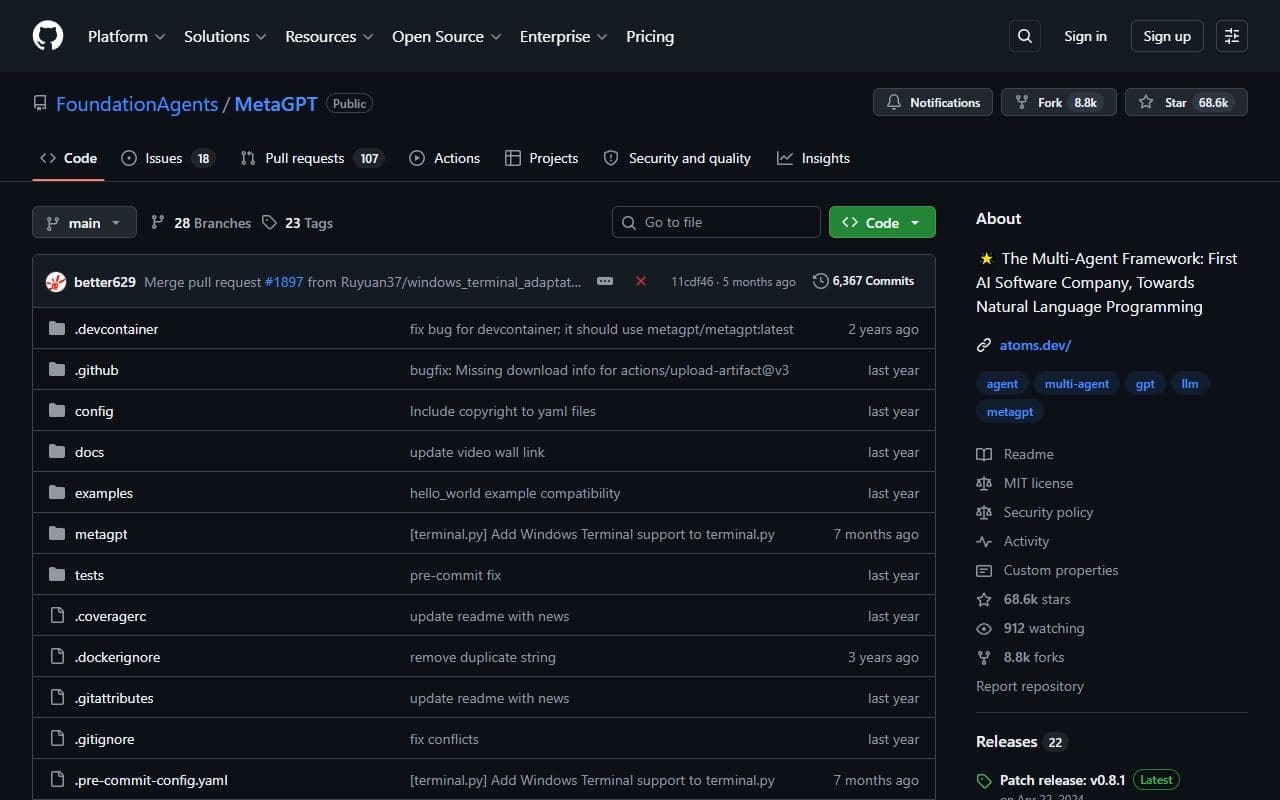
Open-source multi-agent framework that simulates software company roles and collaborative agent workflows.
Directory description / not source-linked
Additional AI-assisted overview
MetaGPT is an open-source multi-agent framework that offers a sophisticated approach to automation by simulating collaborative workflows.
It is engineered to mimic the organizational structure and operational dynamics of a software company, enabling the orchestration of multiple AI agents, each assigned specific roles within a simulated team. This framework is categorized under automation, providing a robust platform for developing and deploying systems where different AI entities can interact and contribute towards common objectives, much like human team members in a coordinated effort. The platform's core strength lies in its ability to facilitate complex, collaborative agent workflows. It provides a structured environment for agents to perform their assigned functions in a coordinated manner, addressing the growing need for intelligent automation solutions that extend beyond simple task execution. As an open-source project, MetaGPT offers transparency and flexibility, allowing developers and organizations to integrate advanced multi-agent capabilities into their automation strategies with full control over the underlying architecture. By establishing a foundational structure for simulating collaborative environments, MetaGPT empowers users to design and deploy sophisticated agent systems capable of tackling multifaceted challenges. It achieves this by distributing responsibilities among specialized AI roles, fostering a more dynamic and adaptive approach to various automation requirements and enabling the emulation of intricate organizational processes.
Unverified fallback. This legacy AI-assisted copy is not used as evidence for the structured facts or decision guidance on this page.
Capabilities
Source-backed claims are preferred. AI-assisted fallback items are labelled individually.
Open-source multi-agent framework
AI-assisted fallback / unverified
Simulates software company roles
AI-assisted fallback / unverified
Supports collaborative agent workflows
AI-assisted fallback / unverified
Designed for automation applications
AI-assisted fallback / unverified
Enables multi-agent system development
AI-assisted fallback / unverified
Facilitates role-based AI interactions
AI-assisted fallback / unverified
Provides a structured simulation environment
AI-assisted fallback / unverified
Use cases
Source-backed claims are preferred. AI-assisted fallback items are labelled individually.
Simulating entire software development team operations
AI-assisted fallback / unverified
Automating complex projects requiring multi-agent coordination
AI-assisted fallback / unverified
Designing and testing collaborative AI workflows
AI-assisted fallback / unverified
Developing AI systems with distinct, role-based responsibilities
AI-assisted fallback / unverified
Creating automated solutions for organizational process emulation
AI-assisted fallback / unverified
How ClawSites assesses MetaGPT
No source-backed best-for or limitation claim is published yet. Unsupported conclusions are omitted until a checked source supports them.
Method: ClawSites keeps discovery copy separate from publishable claims, retains a source excerpt, and displays the date each cited source was checked. Pricing and availability can still change after that date.
Related to MetaGPT
Similar directory context, not an editorial claim that these products are interchangeable.
Open-source automation platform with AI workflow support and app integrations for agentic automations.

Open-source Python framework and AgentOS runtime for building, serving, and operating AI agents.
Enterprise voice AI platform for building, running, and monitoring phone agents that handle real customer conversations.
Platform for building AI agents and conversational assistants with integrations and workflow automation.
Open-source multi-agent framework and research ecosystem for building communicative AI agent systems.
Archived open-source browser-based autonomous agent project for assembling, configuring, and deploying AI agents.