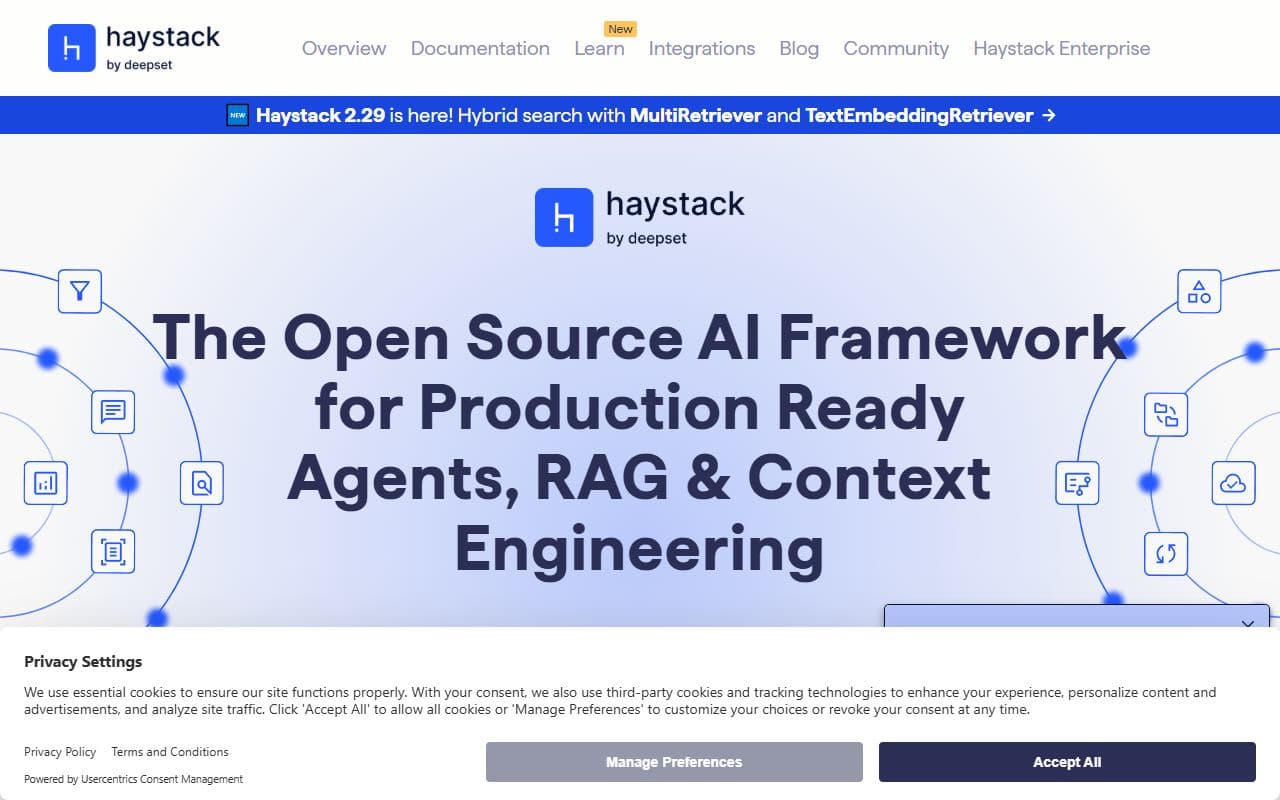
Screenshot of Haystack - DOCS tool built with OpenClaw

Haystack

About Haystack

Haystack is an open-source framework engineered for the comprehensive development of sophisticated artificial intelligence applications. This robust platform provides developers with the essential tools to construct systems specializing in information retrieval, automated question-answering, and advanced agentic AI functionalities. Its architectural design is founded upon the principles of modularity, utilizing pipelines and reusable components to facilitate efficient and scalable application creation. By adopting Haystack, users can effectively orchestrate complex AI workflows, integrating diverse capabilities to process and analyze information dynamically. The framework's open-source nature ensures accessibility and encourages community collaboration, fostering continuous innovation within the AI development landscape. It serves as a foundational toolkit for transforming raw data into actionable insights through intelligent retrieval mechanisms and precise answer generation. Haystack is particularly well-suited for developers aiming to build custom AI solutions that require a flexible and extensible architecture, enabling the creation of intelligent systems capable of interacting, retrieving, and processing information autonomously and effectively.

Key Features

  • Open-source AI framework
  • Supports building retrieval AI applications
  • Supports building question-answering AI applications
  • Supports building agentic AI applications
  • Utilizes pipelines for application construction
  • Employs components for modular development
  • Provides tools for developing AI agents

Use Cases

  1. Developing custom information retrieval systems

  2. Implementing advanced natural language question-answering solutions

  3. Building intelligent AI agents for various tasks

  4. Constructing modular and scalable AI application pipelines

  5. Creating open-source AI applications for community contribution

/// REVIEW GUIDE

How to evaluate Haystack

Haystack is listed in the Documentation category of the ClawSites directory. Use this page as a starting point for judging whether the tool fits a real OpenClaw or AI agent workflow. The listing summary says: Haystack is an open-source framework engineered for the comprehensive development of sophisticated artificial intelligence applications. This robust platform provides developers with the essential tools to construct systems specializing in information retrieval, automated question-answering, and advanced agentic AI functionalities. Its architectural design is founded upon the principles of modularity, utilizing pipelines and reusable components to facilitate efficient and scalable application creation. By adopting Haystack, users can effectively orchestrate complex AI workflows, integrating diverse capabilities to process and analyze information dynamically. The framework's open-source nature ensures accessibility and encourages community collaboration, fostering continuous innovation within the AI development landscape. It serves as a foundational toolkit for transforming raw data into actionable insights through intelligent retrieval mechanisms and precise answer generation. Haystack is particularly well-suited for developers aiming to build custom AI solutions that require a flexible and extensible architecture, enabling the creation of intelligent systems capable of interacting, retrieving, and processing information autonomously and effectively.

Treat the public website at haystack.deepset.ai as the source of truth for setup details, pricing, account requirements, and current availability. ClawSites can help you discover and compare options, but the final decision should come from testing the tool with a narrow workflow, low-risk data, and a clear review step.

The most important question is whether Haystack can move a task from input to useful output while keeping the operator in control. For agent tools, control means knowing what data the tool can access, what actions it can take, what it logs, and how a person can stop or correct it.

Workflow fit

Haystack should be evaluated against a specific documentation job, not just a broad agent-tool label.

Setup effort

Check whether the tool needs an account, API key, local runner, browser access, or messaging channel before it can produce useful output.

Human review

Prefer a setup where a person can inspect inputs, approve risky actions, and correct outputs before the tool touches production work.

Evidence trail

Look for logs, screenshots, citations, status history, or other artifacts that make agent work explainable after the fact.

CategoryDocumentation
Pricing signalFree
Status signalonline
Structured detailsThis listing includes additional feature, use-case, or tag context.

A practical first test for Haystack is to choose one task, write down the expected result, and run the tool without giving it more access than that task requires. If the result is useful, repeat the same test with a slightly messier input. If the tool still produces traceable output and makes failures visible, it is a stronger candidate for a larger workflow.

Compare Haystack with other tools in the Documentation category when you need to understand tradeoffs. One tool may be better for a quick prototype, another for team permissions, another for local control, and another for polished reporting. The right choice depends on the workflow boundary, not on a single popularity score.

Comparison questions

Start by comparing Haystack against the manual version of the same task. If the current workflow is already fast, clear, and low-risk, an agent tool needs to save enough review time to justify the extra setup. If the current workflow depends on copying information between tabs, checking the same sources repeatedly, or waiting for a teammate to prepare context, the tool may have a stronger case.

Next, decide what a bad result would cost. Some documentation workflows are easy to reverse because the output is a draft, note, table, or research summary. Others touch customer communication, public publishing, credentials, production data, or paid actions. Use Haystack first where mistakes are visible and reversible, then raise the access level only after the tool proves it can fail clearly.

Check whether the output fits the place where your team already works. A useful tool should make the next step easier, whether that means a clean export, a shareable link, a saved transcript, a pull request, a ticket, a message draft, or a report that someone can review. If the result has to be rewritten before it can be used, the time savings may disappear.

Finally, define the success metric before the test starts. For Haystack, a fair metric might be minutes saved, fewer handoffs, better source coverage, faster first draft quality, easier status tracking, or fewer repeated checks. A simple scorecard keeps the decision grounded and makes it easier to compare this listing with other tools in the ClawSites directory.

Directory notes versus official details

Use ClawSites to understand where Haystack sits in the broader agent-tool landscape, then use haystack.deepset.ai to confirm the current product facts. Directory pages are useful for discovery, comparison, and workflow framing. Official product pages are the better place to verify supported platforms, account limits, security documentation, pricing pages, trial terms, and release notes.

If you are building a stack around OpenClaw or another agent runner, keep a short evaluation note with the date tested, the workflow tested, the access granted, and the result. Agent tools can change quickly, and a note from the first evaluation helps future reviewers understand why Haystack was accepted, rejected, or kept as a backup option.

Re-check the listing when the workflow changes. A tool that is a poor fit for fully autonomous execution may still be useful for assisted research, drafting, monitoring, triage, or QA. A tool that works well for one user may need more review gates before it fits a team process. The strongest evaluation is specific to the job, the data, and the person responsible for approval.

Keep the first evaluation note short but concrete: the date tested, the account or dataset used, the task attempted, the output reviewed, and the reason the tool did or did not move forward. That record is useful when Haystack changes its onboarding, pricing, documentation, integration surface, or safety controls. It also helps future reviewers understand whether the listing is a daily workflow candidate, a narrow utility, or an interesting tool to revisit later.

Adoption checklist

Before adopting Haystack, document the exact task it will handle and the system that remains responsible for final approval. For example, a tool can gather research, draft a response, or prepare a report, while a person still approves publication, spending, deletion, or access changes. Writing that boundary down prevents a useful helper from becoming an unclear automation risk.

Confirm what data the tool needs and whether that data can be safely shared. Many agent workflows start with harmless public pages and later expand into private documents, customer records, inboxes, analytics, or billing systems. A careful rollout keeps the first test small, limits credentials, and expands access only after the tool has shown consistent behavior.

Check how Haystack behaves when the input is incomplete. A reliable AI agent tool should ask for clarification, skip unsafe steps, or produce a clearly marked partial result instead of pretending that every task succeeded. This is especially important for documentation workflows where bad assumptions can create duplicated work or misleading status updates.

Keep a comparison note while testing. Record the setup time, output quality, review effort, failure mode, and whether the tool saved enough time to justify adding it to your stack. That note makes it easier to compare Haystack against other ClawSites listings and decide whether it belongs in a daily workflow, a one-off experiment, or a future watchlist.

Also decide who owns the follow-up review. A listing can look useful today and become stale when the product changes its permissions, model provider support, onboarding flow, or pricing. If Haystack becomes part of a recurring workflow, assign a simple retest date and keep the official source link in the decision note so future users can confirm the facts before expanding access.

If the follow-up owner is unclear, keep Haystack in discovery mode. A tool should not receive broader access until someone can explain when it will be checked again and what evidence would justify continued use.

Start small

Run the tool on one low-risk task before connecting sensitive accounts, payment systems, or production data.

Keep review visible

Use a workflow where a human can inspect the result, understand the source context, and stop the next action if needed.

Revisit regularly

Agent tools change quickly, so re-check pricing, permissions, documentation, and output quality after major updates.

Get the best OpenClaw Agents in your inbox

Join 8,000+ developers discovering the top autonomous AI tools, use cases, and scraping frameworks every week.

Unsubscribe at any time. We hate spam too.